More brands and agencies are building in-house video teams. For steady, repeatable content, it's a smart move: someone who knows the brand, sits in the meetings and can turn around a social clip by Friday.
But most videographer job posts ask for the same thing: a great reel. A reel shows what someone made. It doesn't show how they work, what they did when the light was bad or the audio failed, or how much of that reel was their job versus a crew's.
If this person is going to plan, shoot, edit and deliver your content, you're not hiring a camera operator. You're hiring six skills in one person. Here's what to screen for, and one interview question to test each.
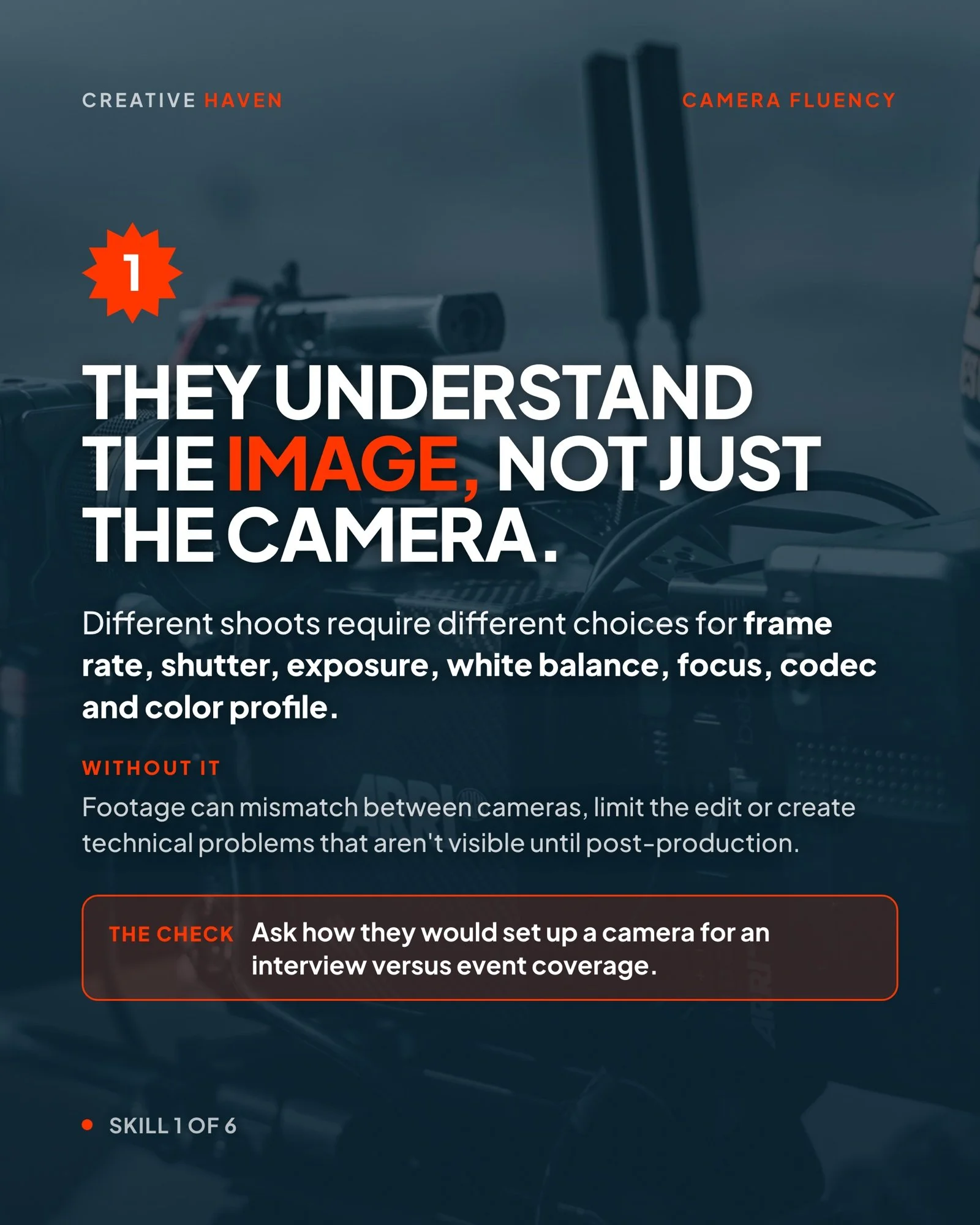
1. Camera fluency: they understand the image, not just the camera
Cameras change. You'll buy one, rent another for a bigger shoot and borrow a third in a pinch. A strong videographer is trained in the fundamentals that carry across all of them: frame rate, shutter, ISO, aperture, white balance, focus, codec and color profile.
Those choices change with the job. An interview, a product close-up and fast event coverage each call for different settings. A videographer who understands why (for example, keeping shutter speed around double the frame rate for natural motion, or shooting a log profile only when there's time to color grade it) gives you footage that matches between cameras and holds up in the edit.
Without it: footage mismatches between cameras, limits what the editor can do, or hides technical problems that don't show up until post-production.
Ask: "How would you set up a camera for an interview versus event coverage?"
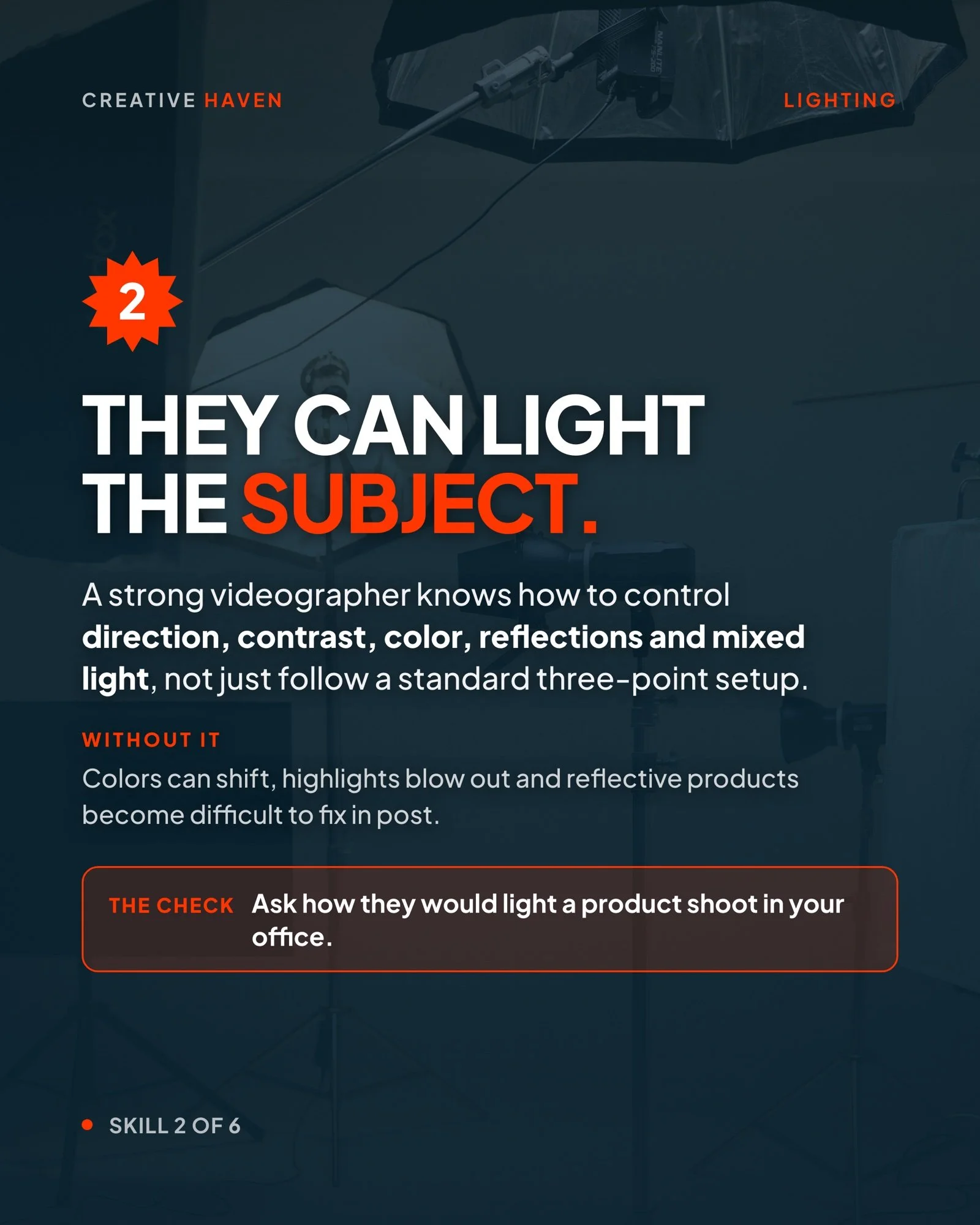
2. Lighting: they can light the subject
Three-point lighting is the starting point, not the skill. The real skill is controlling direction, contrast, color, reflections and mixed light in the rooms you actually shoot in: offices with overhead fluorescents, kitchens with a window on one side, warehouses with no power where you need it.
That includes knowing color temperature. Daylight sits around 5600K and tungsten around 3200K, and mixing them on a face without correcting it is one of the fastest ways to make content look amateur. Products bring their own problems: glossy packaging, glass and metal reflect everything in the room.
Without it: colors shift, highlights blow out, and reflective products become difficult or impossible to fix in post.
Ask: "How would you light a product shoot in our office?"
3. Audio: they know how to capture clean sound
Viewers will forgive a soft shot. They leave over bad sound. A strong videographer knows which microphone fits the situation (lavalier, shotgun, handheld or a podcast setup), where to place it, how to monitor levels with headphones, and when a backup recording is worth the extra minute.
They should also know where the sound is going: into the camera, into an external recorder, or both. For dialogue, 24-bit / 48 kHz WAV is the common production standard.
Without it: background noise, echo, clothing rustle, interference or clipping can make otherwise strong footage difficult, or impossible, to use.
Ask: "Which microphones would you use for a filmed podcast interview?"
4. Pre-production and coverage: they shoot for the story and the edit
Good footage and a usable edit are not the same thing. Strong videographers turn the brief into story beats, interview prompts and a shot list before they arrive. On set, they capture wides, mediums, close-ups, inserts and cutaways, with complete actions and clean eyelines, so the editor has what they need to shape the story.
Today that also means framing for more than one format. A shoot that will become a 16:9 YouTube video, a 4:5 feed post and a 9:16 Reel needs to be framed with all three crops in mind.
Without it: you end up with attractive footage but no usable sequence: missing transitions, incomplete actions and too few cutaways to cut the story together.
Ask: "Which shots would you capture for a company overview video?"
5. Post-production: they ingest, edit and deliver cleanly
Editing is only part of post. Before the first cut, footage needs to be ingested, backed up, renamed and organized so anyone on the team can find it next month. Mixed cameras mean mixed formats and frame rates, and a good editor handles that without breaking the timeline.
At the end, they export the right codec, resolution and bitrate for each destination: 9:16 at 1080×1920 for Reels, TikTok and Shorts; 4:5 or 1:1 for feeds; 16:9 for YouTube and your website, with captions kept clear of each app's on-screen buttons. And they edit in your house style, not just theirs.
Without it: footage gets lost or mislabeled, old assets become hard to find, and oversized or poorly compressed exports lose quality after upload.
Ask: "How do you organize and ingest footage before you start editing?"
6. Collaboration: they work well with the team
An in-house videographer works with marketing, creative, leadership and on-camera talent, often in the same week. A strong one asks what assets are needed before the shoot, raises concerns early, puts nervous talent at ease, and offers creative ideas while keeping production aligned with the brief.
Just as important: they take notes without taking them personally.
Without it: feedback becomes personal, revisions become frustrating, and a technically strong hire can still create a difficult team environment.
Ask: "How do you handle feedback and multiple rounds of revisions?"
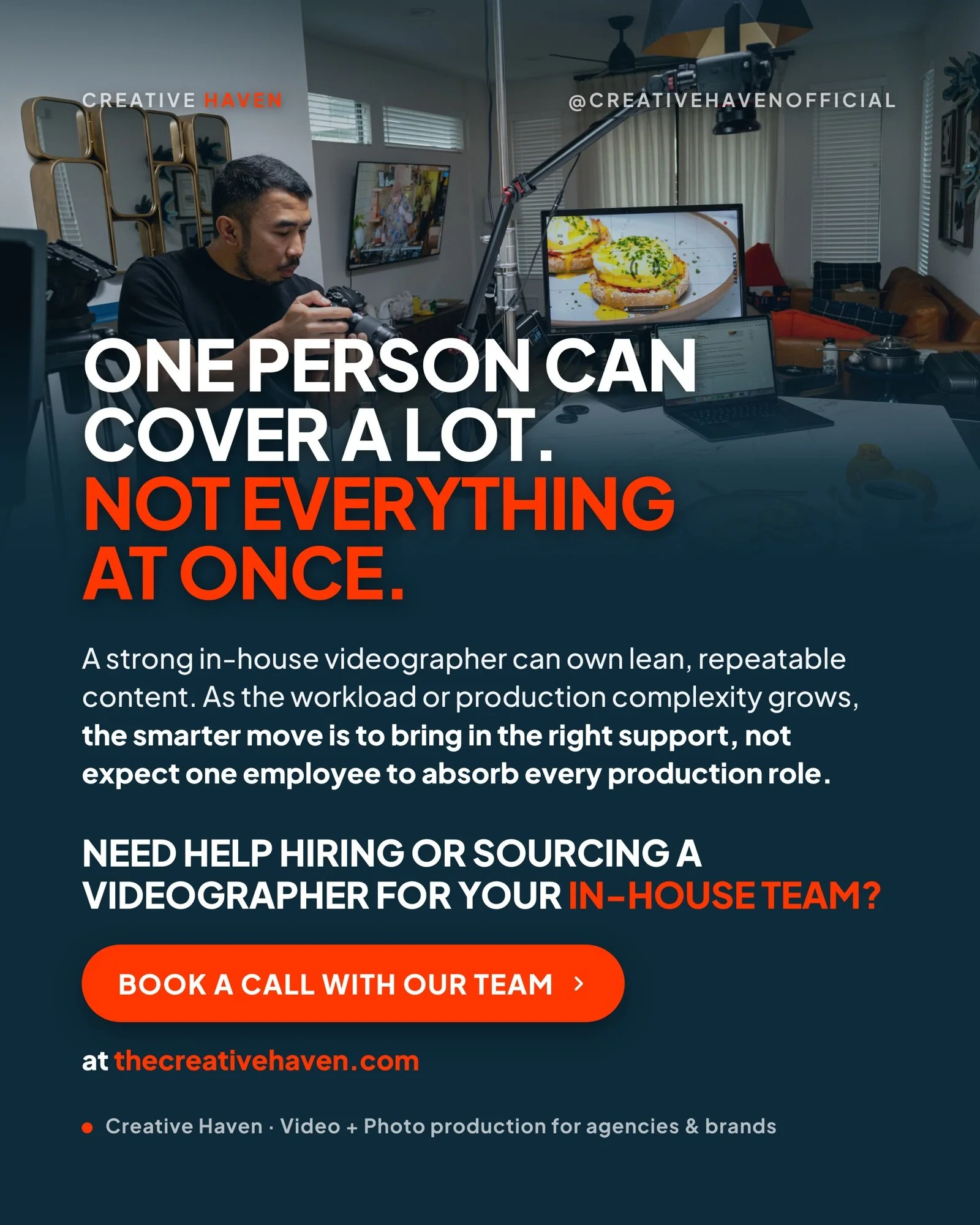
One person can cover a lot. Not everything at once.
Read that list again and you'll notice it describes a crew: a camera operator, a gaffer, a sound mixer, a producer, an editor and a project manager. A strong in-house videographer can own lean, repeatable content, and the right hire is worth a lot.
But as the workload or production complexity grows (a multi-camera interview, a product launch, a month of content in one shoot day), the smarter move is to bring in the right support, not expect one employee to absorb every production role. That's how in-house teams stay fast without burning out the person you just hired.
Need help with your in-house video team?
At Creative Haven, we've spent more than 20 years on sets, with credits including HBO and Sony and brands like Stella Rosa, Halo Top and Tapatio. We help agencies and brands hire and source the right videographer, and we bring a full crew when one person isn't enough.
FAQ
What skills should an in-house videographer have?
Six core skills: camera fluency, lighting, audio capture, pre-production and coverage, post-production and delivery, and collaboration with the team.
Is a great reel enough to hire a videographer?
No. A reel shows finished work, not how the person works. Ask scenario questions, like how they would light a product shoot in your office or mic a two-person interview.
When should a brand hire a production studio instead of adding in-house staff?
When the workload or production complexity outgrows one person: multi-camera shoots, product launches, or batch shoot days that need lighting, sound and camera running at the same time.